Why Is My RV Battery Not Charging? Common Causes and Troubleshooting Tips

An RV battery that will not charge can affect lighting, slide-outs, water pumps, control boards, appliances, safety equipment, and other 12-volt systems. The cause may be as simple as a loose connection or tripped breaker, but it can also involve the battery, converter, charger, wiring, fuses, disconnect switch, or shore-power supply.
The direct answer: An RV battery may not charge because the battery is damaged or deeply discharged, the terminals are loose or corroded, the battery disconnect is off, a fuse or breaker has failed, shore power is unavailable, or the RV converter or charging system is not operating correctly.
Some basic checks can be completed safely by an RV owner. Electrical testing, internal wiring repairs, and converter diagnostics should be handled by an experienced RV technician.
How Does an RV Battery Charging System Work?
Most RVs use one or more batteries to supply 12-volt direct-current power when the RV is not connected to an external electrical source.
Depending on the RV, the batteries may be charged through:
Shore power and the RV converter or charger
The motorhome alternator while driving
A tow vehicle’s charging connection
A generator
Solar panels and a solar charge controller
A standalone battery charger
When the RV is connected to shore power, the converter typically changes 120-volt alternating current into 12-volt direct current. This powers many RV systems and replenishes the battery.
A problem anywhere between the electrical source and the battery can interrupt charging.
How Can You Tell Whether Your RV Battery Is Not Charging?
Common signs include:
Interior lights becoming dim
The water pump slowing down
Slide-outs operating slowly
Appliances failing to start
Control panels shutting off
The battery repeatedly going dead
Battery voltage continuing to drop
The RV having power only while plugged into shore power
The battery not recovering after several hours of charging
Warning lights or low-voltage messages appearing
The generator being difficult to start
Safety detectors chirping or resetting
These symptoms do not always mean the battery itself has failed. A charging-system problem can create similar signs.
Why Is My RV Battery Not Charging?
1. The Battery Disconnect Switch Is Off
Many RVs have a battery disconnect switch that separates the house battery from parts of the 12-volt system.
The switch may be labeled:
Battery
Battery Disconnect
Store/Use
Coach Power
Salesman Switch
If the switch is in the storage or disconnected position, the battery may not supply power normally and may not charge through certain systems.
What to check
Confirm that the battery disconnect is in the operating or “use” position.
Some systems may still power selected equipment even when the disconnect switch is off, so the presence of lights or shore power does not always prove that the battery is connected correctly.
2. The RV Is Not Receiving Shore Power
Before assuming the battery or converter has failed, confirm that electrical power is reaching the RV.
Possible shore-power issues include:
A disconnected power cord
A damaged plug
A tripped campground pedestal breaker
A tripped household breaker
A failed adapter
A damaged extension cord
A faulty surge protector
Low or unstable incoming voltage
A loose connection at the RV inlet
Basic checks
Confirm the power cord is fully connected.
Check the breaker at the pedestal or power source.
Look for warning lights on the surge protector.
Confirm that 120-volt appliances or outlets are receiving power.
Inspect the cord and plug for heat damage, discoloration, or melting.
Do not continue using damaged electrical cords, plugs, adapters, or outlets.
3. A Circuit Breaker Has Tripped
The converter or battery charger may be supplied by a 120-volt circuit breaker inside the RV’s electrical panel.
If that breaker trips, the converter may stop charging the battery even though other circuits still work.
What to do
Locate the electrical panel and identify the breaker labeled for the converter, charger, or related circuit.
To reset a tripped breaker:
Move it fully to the off position.
Move it back to the on position.
Monitor whether it trips again.
If the breaker trips repeatedly, do not keep resetting it. Repeated tripping may indicate an electrical fault, overloaded circuit, damaged wiring, or failing component.
4. A Fuse Has Blown
RV charging systems may use several types of fuses, including:
Converter fuses
Battery-protection fuses
Reverse-polarity fuses
Inline fuses
High-amperage battery fuses
Distribution-panel fuses
A blown fuse can interrupt the path between the converter and the battery.
Important
Replace a fuse only with the same approved type and amperage rating.
Never install a larger fuse to prevent it from blowing. The fuse protects the wiring and equipment from excessive current.
If a replacement fuse blows again, the underlying problem should be diagnosed before further operation.
5. The Battery Terminals Are Loose or Corroded
Loose, dirty, or corroded battery terminals can prevent efficient charging and power delivery.
Look for:
White, blue, or green residue
Loose cable connections
Frayed cables
Damaged terminal ends
Heat discoloration
Cracked insulation
Broken battery posts
Rusted hardware
Poor connections can create resistance, voltage loss, and heat.
Safety precautions
Before working around a battery:
Disconnect external power when appropriate.
Turn off appliances and charging sources.
Remove jewelry.
Wear eye protection and gloves.
Avoid creating sparks.
Follow the battery manufacturer’s instructions.
Battery acid and gases can be hazardous. Stop if the battery is leaking, swollen, unusually hot, cracked, or producing a strong odor.
6. The Battery Is Deeply Discharged
A battery that has been left unused or connected to small electrical loads may become deeply discharged.
Common parasitic loads include:
Propane detectors
Carbon-monoxide detectors
Stereo memory
Control boards
Clocks
Inverters
Monitoring systems
Aftermarket accessories
Some charging systems may not recognize or recover a severely discharged battery normally.
A deeply discharged battery may also have suffered permanent capacity loss, especially if it remained discharged for an extended period.
7. The Battery Is Old or Damaged
RV batteries do not last indefinitely. Their service life depends on:
Battery type
Charging habits
Depth of discharge
Storage conditions
Temperature
Maintenance
Number of charge cycles
Electrical loads
Signs of a failing battery may include:
Rapid loss of charge
Reduced runtime
Slow charging
Failure to reach a full charge
Low voltage shortly after charging
Swelling
Cracks
Leakage
Corroded or damaged terminals
A battery can show an acceptable voltage immediately after charging but still have limited capacity under load. A proper battery evaluation may require both voltage and load testing.
8. The Converter or Charger Is Not Working
The converter is a common charging source when the RV is connected to shore power.
Possible converter problems include:
No incoming 120-volt power
Blown fuses
A tripped breaker
Loose wiring
Internal component failure
Overheating
Blocked ventilation
A failed cooling fan
Incorrect charging output
Improper battery settings
Signs of a converter problem
The battery does not charge while connected to shore power
12-volt systems weaken even though the RV is plugged in
The converter fan never operates or runs constantly
The converter becomes unusually hot
Fuses repeatedly blow
Voltage does not increase when shore power is connected
The converter makes unusual noises
A burning smell is present
Turn off the system and seek professional help if you notice smoke, melted wiring, excessive heat, or a burning odor.
9. The Battery Cables Are Damaged
A cable may look connected while having internal corrosion, broken strands, or damage beneath the insulation.
Possible issues include:
Corrosion inside a cable
Loose crimped terminals
Broken ground connections
Undersized replacement cables
Heat-damaged insulation
Rodent damage
Improper routing
Poor frame-ground contact
A weak ground connection can produce intermittent electrical symptoms that resemble battery or converter failure.
Cable and ground testing may require voltage-drop measurements under load.
10. The Battery Is Connected Incorrectly
Incorrect polarity can damage fuses, converters, chargers, control boards, and other electrical components.
This can happen after:
Battery replacement
Seasonal storage
Maintenance
Installing multiple batteries
Reconfiguring a battery bank
Adding solar or an inverter
Important warning
Do not rely only on cable color. Previous repairs or modifications may not follow standard color conventions.
Before reconnecting a battery, verify the correct positive and negative connections using the RV’s wiring information or professional testing.
11. The Alternator Is Not Charging the House Battery
Some motorhomes charge the house batteries from the engine alternator while driving.
If the house battery does not charge on the road, possible causes include:
A failed isolator
A faulty battery-combiner relay
A damaged solenoid
Blown high-amperage fuses
Wiring problems
Alternator issues
Battery-management system settings
The chassis battery may still charge normally while the house battery does not.
Diagnosing this system often requires testing both battery banks while the engine is running.
12. The Tow Vehicle Is Not Charging the Trailer Battery
Travel trailers and fifth wheels may receive limited charging power through the tow vehicle’s electrical connector.
Charging problems may involve:
A missing charge wire
A blown tow-vehicle fuse
A damaged trailer connector
Corroded pins
Poor grounding
Insufficient wire size
A disconnected battery
Vehicle-specific charging controls
The tow vehicle’s connection may maintain a battery during travel, but it may not quickly recharge a deeply discharged battery.
13. The Solar Charging System Has a Problem
An RV solar system normally includes:
Solar panels
Wiring
Fuses or breakers
A charge controller
A battery bank
Monitoring equipment
Possible solar-charging issues include:
Shaded or dirty panels
Loose wiring
A tripped breaker
Blown fuses
Incorrect controller settings
Controller failure
Damaged panels
Battery-temperature restrictions
Battery-management system protection
Insufficient sunlight
A solar display showing panel voltage does not necessarily confirm that useful charging current is reaching the battery.
14. The Battery Type and Charger Settings Do Not Match
Common RV battery types include:
Flooded lead-acid
AGM
Gel
Lithium iron phosphate
These batteries may require different charging profiles.
Incorrect settings can result in:
Incomplete charging
Overcharging
Reduced battery life
Charger fault codes
Battery-management system shutdown
Poor cold-weather performance
When replacing an RV battery with a different chemistry, confirm that the converter, solar controller, inverter charger, alternator-charging equipment, and monitoring system are compatible.
15. Cold Temperatures Are Affecting Charging
Cold weather affects battery performance and charging behavior.
Lead-acid batteries may have reduced usable capacity in cold conditions. Many lithium batteries include protection systems that restrict charging below certain temperatures unless the battery has internal heating or another approved cold-weather solution.
Do not attempt to override a battery-management system’s temperature protection.
Follow the battery and charging-equipment manufacturers’ requirements.
How to Check Whether an RV Battery Is Charging
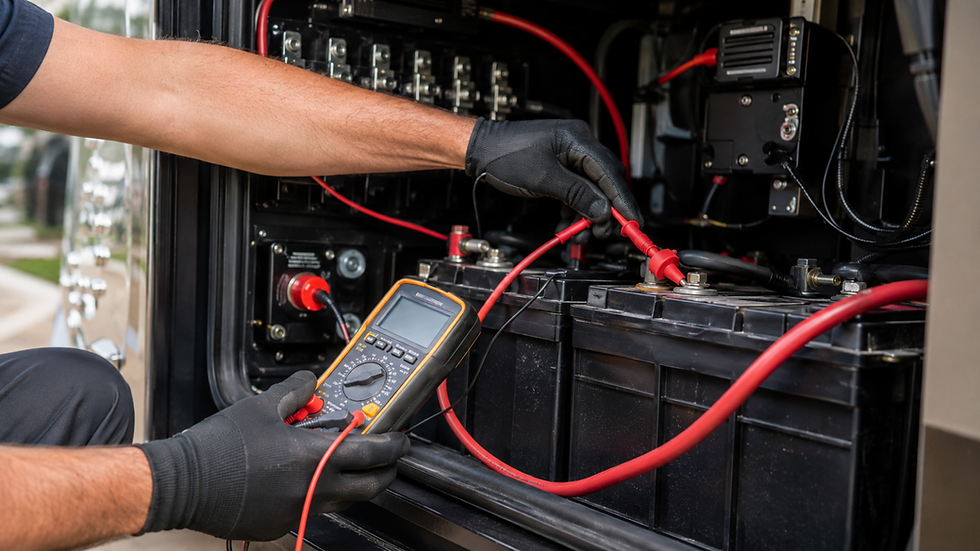
A digital multimeter can help determine whether charging voltage is reaching the battery, but electrical testing should only be performed by someone who understands meter safety and battery systems.
General voltage-check process
Turn off unnecessary 12-volt loads.
Allow the battery to rest when possible.
Measure voltage directly at the battery terminals.
Connect the RV to an approved charging source.
Measure the battery voltage again.
Compare the readings with the battery and charger manufacturers’ specifications.
When a charging system is working, the voltage at the battery will typically rise above its resting voltage. The correct range depends on the battery type, charging stage, temperature, and equipment.
A single voltage reading does not provide a complete diagnosis. The system may also require:
Load testing
Converter-output testing
Current measurements
Voltage-drop testing
Battery-capacity testing
Ground-circuit testing
Charge-controller diagnostics
What Can an RV Owner Safely Check?
Many owners can perform the following basic checks:
Confirm the RV is connected to shore power
Verify that the pedestal or source breaker is on
Check the battery disconnect switch
Inspect visible battery terminals
Look for corrosion or loose cables
Check accessible breakers
Inspect approved user-serviceable fuses
Review converter or charger indicator lights
Check solar-controller messages
Look for damaged cords or plugs
Confirm that the battery has not visibly swollen or leaked
Stop troubleshooting when the task involves exposed wiring, high-current battery circuits, internal electrical panels, unknown cable polarity, or components showing signs of overheating.
What Should You Avoid Doing?
Do not:
Install a higher-rated fuse
Bypass a breaker or safety device
Create sparks near a battery
Work around a leaking or swollen battery
Short battery terminals with a tool
Assume cable color proves polarity
Open a converter or inverter without proper training
Touch exposed electrical conductors
Continue operating overheated equipment
Ignore a burning smell
Mix incompatible battery types in the same bank
Use a charger that is not approved for the battery chemistry
RV battery systems can deliver very high current, even though they operate at relatively low voltage.
Why Does My RV Battery Die While Plugged Into Shore Power?
When a battery loses charge while the RV is plugged in, possible causes include:
The converter is not receiving power
The converter has failed
The converter’s breaker is tripped
Charging fuses are blown
The battery disconnect is off
A cable or ground connection is damaged
The battery can no longer hold a charge
Electrical loads exceed the charging system’s output
An inverter or accessory is drawing excessive power
The RV may appear to operate normally while plugged in because the converter is powering some 12-volt equipment. Once shore power is removed, a weak or disconnected battery may immediately become apparent.
Why Does My RV Battery Charge but Die Quickly?
A battery that reaches charging voltage but loses power soon afterward may have:
Reduced capacity
Internal damage
Sulfation
A failing cell
Excessive parasitic loads
An inverter left on
A refrigerator or other heavy load operating from the battery
A wiring fault
Incorrect charger settings
Insufficient charging time
Voltage alone does not measure how much usable energy the battery can deliver. A capacity or load test may be needed.
How Long Should an RV Battery Take to Charge?
Charging time depends on:
Battery capacity
State of charge
Battery chemistry
Charger output
Number of batteries
Electrical loads operating during charging
Battery temperature
Battery condition
Charging stage
A small charger may require many hours to recharge a large or deeply discharged battery bank. Chargers also reduce their output as batteries approach full charge.
Rather than relying on a fixed time estimate, monitor the charging system using the battery and equipment manufacturers’ guidance.
Can You Use the RV While the Battery Is Charging?
In many RVs, 12-volt systems can be used while the battery is charging. However, active electrical loads reduce the amount of charging current available to replenish the battery.
Heavy loads may make charging slower or prevent a weak charging system from increasing battery charge effectively.
If voltage continues to fall while connected to shore power, the charging system should be inspected.
When Should You Replace an RV Battery?
Battery replacement may be appropriate when the battery:
Fails a professional load or capacity test
Cannot hold a useful charge
Has a damaged case
Is swollen
Is leaking
Has broken terminals
Repeatedly becomes deeply discharged
No longer supports normal RV loads
Has reached the end of its practical service life
Do not replace the battery before checking the charging system. A failed converter, wiring problem, or parasitic load can damage a replacement battery or create the same symptoms.
When Should You Call a Mobile RV Technician?
Request professional RV electrical service when:
The battery will not charge from shore power
Fuses repeatedly blow
Breakers repeatedly trip
The converter overheats
Electrical connections become hot
You smell burning insulation
The battery is swollen or leaking
The battery repeatedly dies
The system has been modified
Multiple batteries are connected incorrectly
The alternator does not charge the house batteries
Solar charging is not working
The battery type has been changed
You are unsure how to test the system safely
J&S RV Service offers mobile RV electrical repair and battery-system installation or repair as part of its service offering.
RV Battery Troubleshooting Checklist
If your RV battery is not charging, check the following:
Shore power is connected and available
Power cord and plug appear undamaged
Pedestal or source breaker is on
RV main breaker is on
Converter breaker has not tripped
Battery disconnect is in the operating position
Accessible charging fuses are intact
Battery terminals are clean and secure
Battery cables are not visibly damaged
Battery case is not swollen, cracked, or leaking
Converter or charger indicators appear normal
Solar controller is not displaying a fault
Battery type matches charger settings
No major electrical load is draining the battery
The system has been tested professionally if the problem remains
Mobile RV Battery and Electrical Service in Petersburg, Ohio
J&S RV Service provides mobile RV electrical diagnostics, battery-system repair, and related services from its base in Petersburg, Ohio.
The business operates as a mobile service provider and states that it travels up to approximately 50 miles. Its listed service region includes Mahoning, Columbiana, Trumbull, Portage, and Lawrence counties.
Service may be available at your:
Home
Campground
RV storage location
Other accessible parking location within the service area
Need Help With an RV Battery That Will Not Charge?
Avoid replacing parts without first identifying the cause.
Call J&S RV Service at 330-398-4224 to request mobile RV battery or electrical diagnostics.
Frequently Asked Questions
Why is my RV battery not charging when plugged into shore power?
Possible causes include unavailable shore power, a tripped breaker, blown charging fuse, disconnected battery, loose cable, failed converter, damaged battery, or incorrect charger settings.
How do I know whether my RV converter is charging the battery?
Measure the battery voltage before and after connecting the RV to shore power. A working charging system will generally raise the battery voltage, although the expected reading varies by battery type and charging stage.
Why does my RV battery die even though the RV is plugged in?
The converter may not be charging, the battery may be disconnected, a fuse or breaker may have failed, the battery may be damaged, or the RV’s electrical loads may exceed the charger’s output.
Can a bad RV converter drain the battery?
A converter that stops charging allows normal 12-volt loads to continue drawing power from the battery. Depending on the failure, the converter or related wiring could also create abnormal electrical behavior.
How do I know whether my RV battery is bad?
Common signs include rapid discharge, low capacity, failure to hold a charge, swelling, leakage, damaged terminals, or failure during a professional load or capacity test.
How long does it take to charge an RV battery?
Charging time depends on battery size, discharge level, chemistry, charger output, temperature, condition, and active electrical loads. A deeply discharged battery may require many hours.
Does the battery disconnect switch affect charging?
It can. Charging behavior varies by RV design. In some systems, placing the disconnect in the storage position separates the battery from the converter or parts of the electrical system.
Can a tow vehicle fully charge an RV battery?
A tow vehicle may provide some charging through the trailer connector, but the available current may be limited. It may maintain a battery during travel without quickly recharging a deeply discharged battery.
Why is my RV battery not charging from solar panels?
Possible causes include shade, dirty panels, loose wiring, blown fuses, a tripped breaker, incorrect charge-controller settings, controller failure, low temperatures, or battery-management system protection.
Can a mobile RV technician test my battery and converter?
Yes. A mobile RV technician can inspect the battery, converter, cables, grounds, fuses, charging sources, and related components at the RV’s location when service is available.
Comments